

What States Require A Makeup Air Unit
How to calculate makeup air for Minnesota homes and the 300-cfm myth
Today I'll explicate what makeup air is and when it's required for a Minnesota abode. I'll also go through a few examples to evidence how to do your ain calculation. I wrote about this back in 2013, but the rules accept changed a bit since and so, so it'southward fourth dimension for an update. Here'due south a video where I tried to break it down and brand it simple, but it'south more than than ten minutes long. Then much for that.
WHAT IS MAKEUP AIR
Makeup air is needed in homes to supplant air that is removed by mechanical devices, such as clothes dryers, kitchen frazzle fans, and bathroom exhaust fans. Makeup air is not the same thing as combustion air. Combustion air is needed to support combustion at appliances such as a furnace or water heater. I discussed some of the calculations for combustion air in this weblog post from 2018: Are combustion air ducts needed for large basements?
WHEN MAKEUP AIR IS NEEDED
This is darned complicated, just I'll practice my best to brand it like shooting fish in a barrel to follow. For a new construction home, you demand to follow section 501.4.ane of the 2020 Minnesota State Mechanical Code (MMC). Those requirements aren't as well tough to follow, and the final determination of the calculation can be found with the building plans.
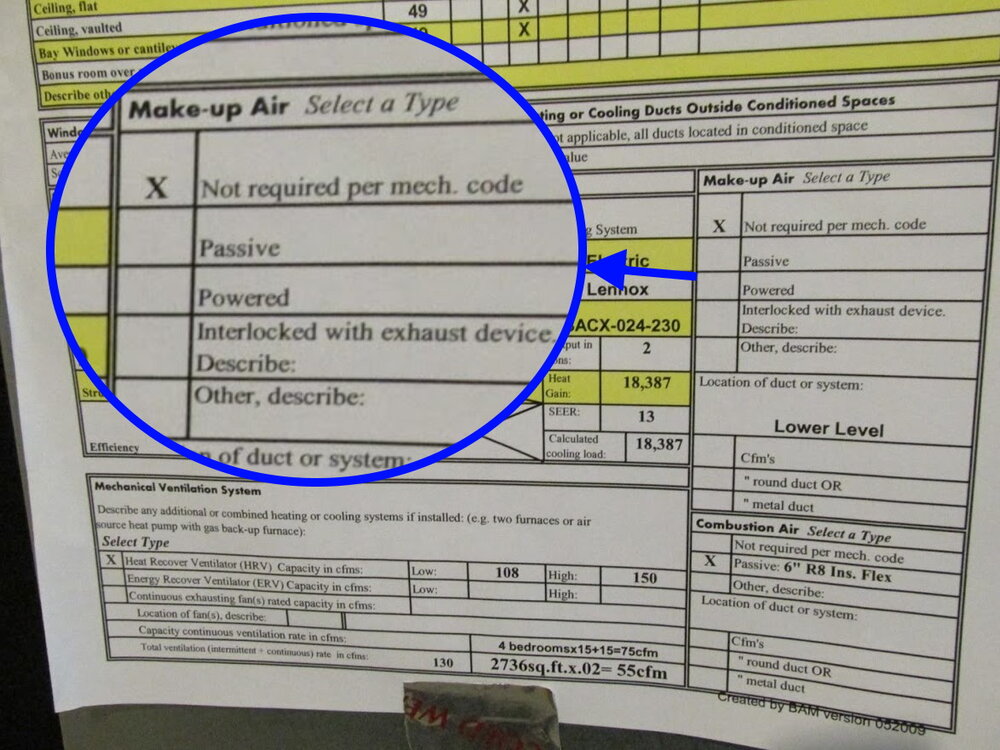
For existing homes, there's no single action that will trigger the need for makeup air. When certain changes or alterations to a domicile'south mechanical arrangement are made, it might trigger the need to do a calculation. The biggest misconception that people have around this is that makeup air is needed anytime a kitchen hood fan over 300-cfm is installed. This does non trigger the need for makeup air. This simply ways that someone needs to practice some math to figure out if makeup air is needed.
There'south a list of six potential triggers for combustion air, institute under section 501.four.3 of the MMC. Information technology's verbose and confusing, and at that place are a bunch of exceptions, and then here'southward my pared-down version to brand it easier to understand. Here are the triggers:
-
When installing or replacing a vented combustion apparatus or an exhaust system on a home built after 1999. For the nearly part. Utilise table 501.4.i to practice the calculation.
-
When installing a solid fuel appliance, such equally a wood-burning fireplace.
-
For homes congenital during or later on 1994, use tabular array 501.iv.i for the calculation.
-
For homes congenital prior to 1994, use table 501.four.3(3) for the calculation.
-
-
When installing an frazzle arrangement with a rated capacity over 300-cfm.
-
For homes built during or subsequently 1994, apply table 501.4.three(1) for the adding.
-
For homes congenital before 1994, use table 501.4.3(2) for the calculation.
-
In all of these cases, if the calculation determines that combustion air is needed, use table 501.4.2 to effigy out how much. And I'll say it again: my language to a higher place is not how the code reads. This is my interpretation. Read the code to become the exact language and to acquire most the exceptions.
Besides the specific exceptions for each rule, there are two general exceptions that can exist made for combustion air. One is to follow ASTM E1998-02 to show that combustion air is not needed. I got my hands on a copy of that standard, and it is laughably verbose and complicated. I'd rather install two powered makeup air systems than try to follow that standard. The other exception is when a exam is performed that is canonical by the building official, proving that the combustion appliances will still function fine without makeup air.
So there yous take information technology. These are the things that trigger the need to practise a makeup air calculation. Adjacent, allow's piece of work through a couple of examples. I'll fill out the forms, and you'll gain an understanding of how to exercise this yourself.
SAMPLE CALCULATIONS
Scenario 1: A 1983-built abode having a bathroom exhaust fan installed, under 300-cfm. This doesn't trigger whatsoever of the three things I listed above, and so no calculation is needed for combustion air.
Scenario two: A 2006-built abode having a gas water heater replaced. This triggers item #1 in my list above, so we'll utilize table 501.four.1 for the adding. For this example, we'll assume the home has a fan-assisted furnace, a natural draft (atmospherically vented) h2o heater, and no fireplace. The home is 3600 sf, and it has a 250 cfm kitchen hood fan. It also has three bath fans, each rated at 80 cfm.
Because this home has one atmospherically vented appliance, we need to use column 3 on this tabular array, which should* give u.s.a. a pressure gene of .06. I'll make full in the numbers for that column.
*I found a typo here in the codebook. The number in this cavalcade says .vi, just information technology'southward supposed to say .06. Please ship the the prize directly to my house, thank you.
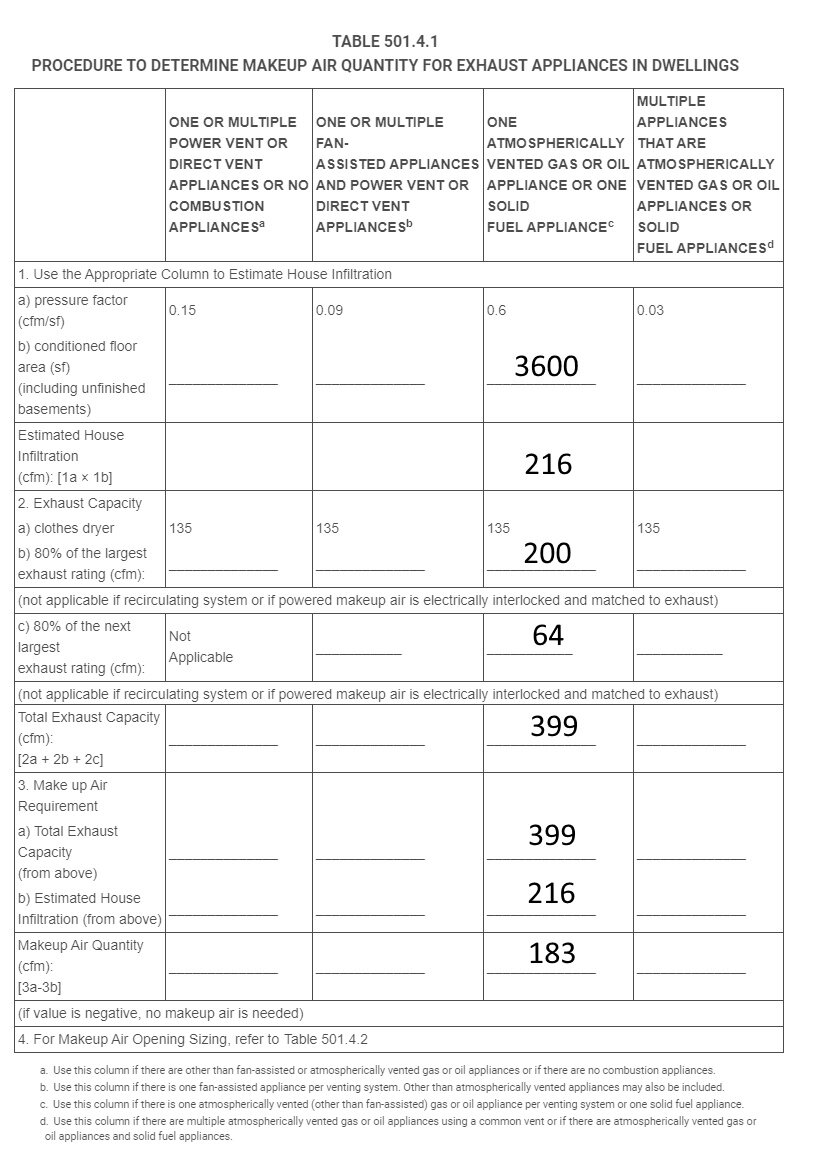
As you can see, makeup air quantity at the bottom is a positive number, so makeup air is required. We take 183 and bring it over to table 501.iv.2, and we employ the same column.
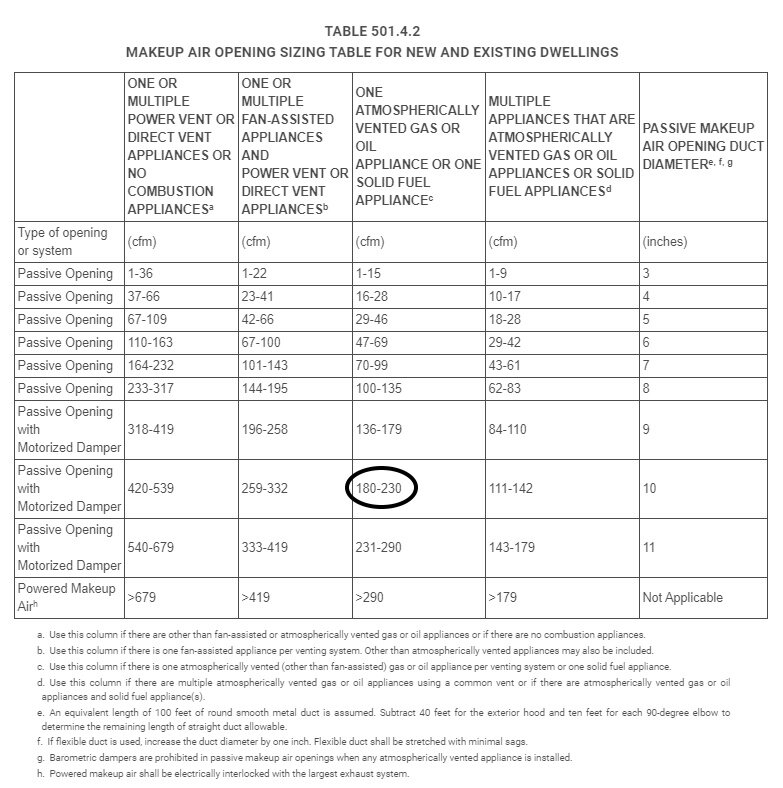
This tells united states of america we'll need a Passive Opening with a Motorized Damper, and the far right cavalcade says the duct size must be 10". Because nosotros'll likely use an insulated flex duct similar everyone else does, footnote f tells us we need to increase the duct diameter past one inch. So we'll need an xi" duct. For the record, that'due south gigantic.
Scenario iii: A 1957-built dwelling house is having a 400-cfm kitchen hood fan installed. This triggers #3 in my list above, and then we'll use the calculation for homes built before 1994, Tabular array 501.4.3(2). For this example, we'll presume the domicile has a fan-assisted furnace, a natural draft (atmospherically vented) water heater, and a woods-burning (solid-fuel) fireplace. The habitation is 1800 sf, and it doesn't take any bath exhaust fans.
Considering this home has multiple appliances that are atmospherically vented or solid fuel appliances, nosotros have to use the far column on the right for this calculation.
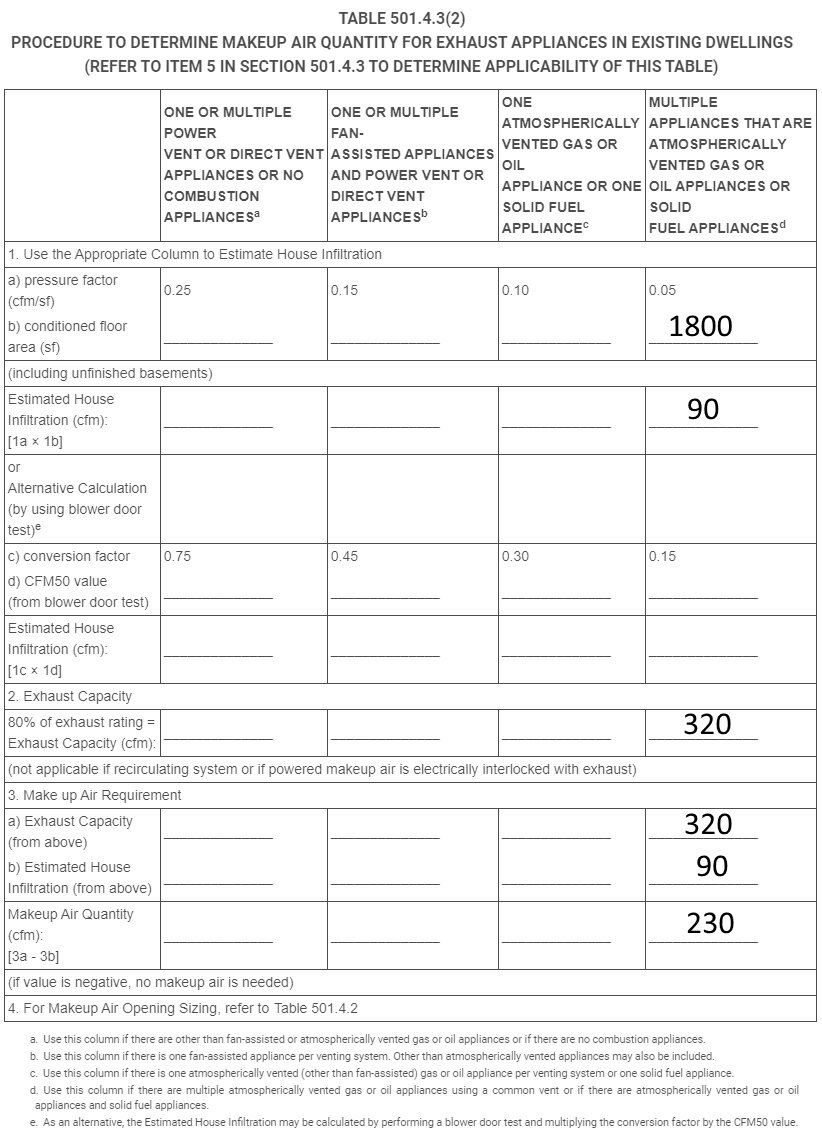
Again, we end up with a positive number, this time information technology'southward 230. We take that over to table 501.4.2, and nosotros use the same column to encounter what size duct we need.
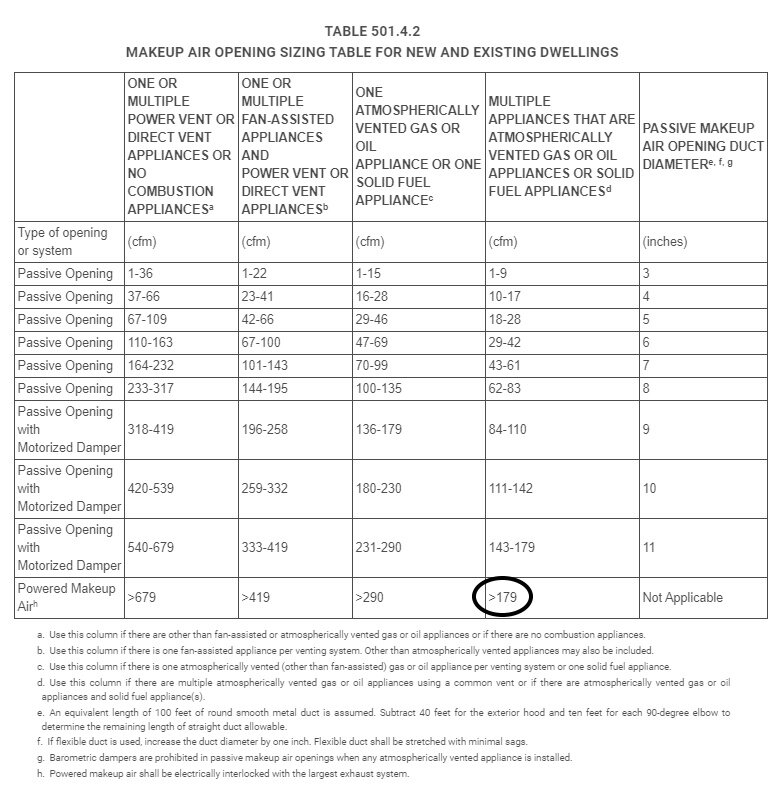
Because nosotros're over 179 cfm, this domicile will need powered makeup air.
Scenario 4: A 1995-built dwelling house is having a 400-cfm kitchen hood fan installed. This triggers #iii, so we'll employ the calculation for homes built later 1994, Table 501.iv.3(1). For this example, we'll assume the home has a direct vent furnace and a powervent h2o heater, and two directly-vent gas fireplaces. The home is 3600 sf, and it has four bathroom exhaust fans, each rated at 80 cfm.
Because we take powervent and direct vent appliances, nosotros get to utilise the get-go column in the table, which is the nearly forgiving.
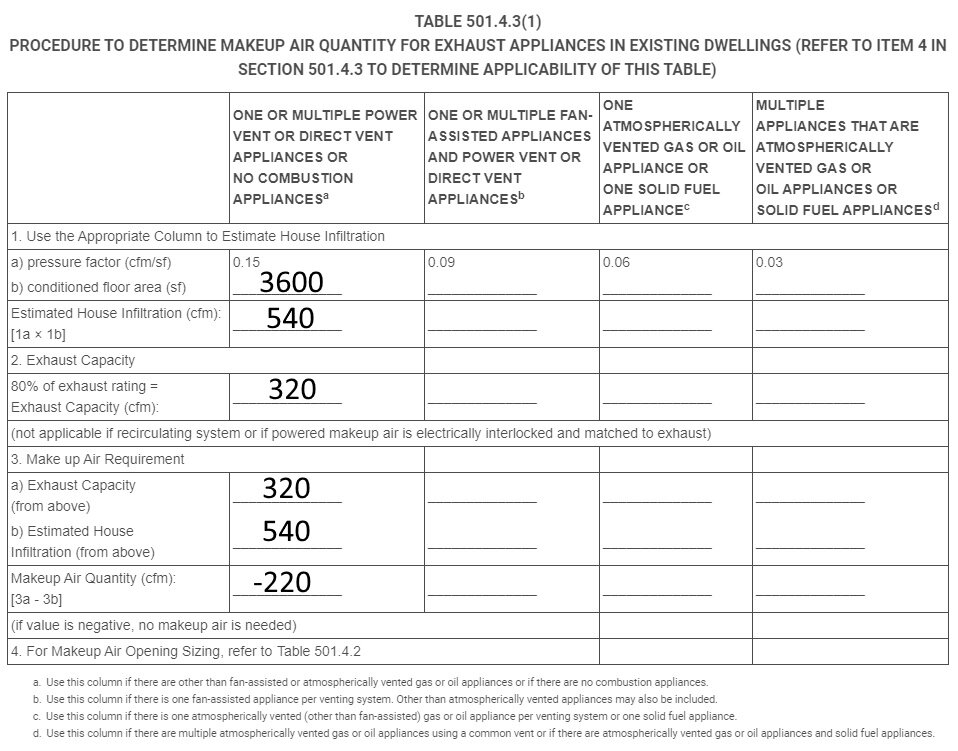
Nosotros end upwards with a negative number in this case, then we don't need to add any makeup air. We could really get away with calculation a kitchen exhaust fan that'southward rated upwardly to 675-cfm, and we notwithstanding wouldn't need to add together any makeup air.
Outside OF MINNESOTA
If you're outside of Minnesota, these rules don't apply to you. While our rules are complex, I recall they're a peachy model for other states to follow. The 2018 version of the International Residential Code has a very small, generic, piece of cake-to-follow section on makeup air, institute under M1503.6:
Where one or more gas, liquid or solid fuel-burning apparatus that is neither direct-vent nor uses a mechanical draft venting system is located within a dwelling unit's air bulwark, each exhaust system capable of exhausting in excess of 400 cubic feet per minute (0.xix m3/s) shall be mechanically or passively provided with makeup air at a rate approximately equal to the frazzle air charge per unit. Such makeup air systems shall exist equipped with not fewer than one damper complying with Department M1503.vi.ii.
To paraphrase: if yous have feeble appliances in your dwelling house that might backdraft, y'all need to add makeup air if you install an exhaust system rated at 400-cfm or more. If you lot add together an exhaust system under 400-cfm, nothing is required.
In my humble opinion, this is a joke. The requirements that we have here in Minnesota, while complicated, are light years alee of this woefully inadequate national formula. This is a smashing example of why Minnesota amends the national codes to better suit our needs.
Decision
Homes that required big-time makeup air in the examples above were the homes that rely on gravity to get frazzle gases out of the homes. As I've said earlier many times, these appliances are feeble, and they demand lots of extra aid to role properly. This is why makeup air is so of import.
As for abode inspections, doing these types of calculations goes way beyond the scope of what we do. But I remember information technology's helpful to understand how these are washed, and to wait over a few examples to fully appreciate why it's unusual to find gas appliances in new homes that are not straight-vent or power-vent, and why it's as well quite unusual to find new homes with wood-called-for fireplaces. And also why you don't want to go nuts with a huge kitchen hood fan.
Related Links:
-
Combustion air ducts, Part 1: Why houses demand them
-
Are combustion air ducts needed for large basements?
Writer:Reuben Saltzman,Construction Tech Home Inspections

Source: https://structuretech.com/how-to-calculate-makeup-air-for-minnesota-homes-and-the-300-cfm-myth/
Posted by: garciasounedithe.blogspot.com
0 Response to "What States Require A Makeup Air Unit"
Post a Comment