

Battlefield V Multiplayer CPU Benchmark: Ryzen 7 2700X vs. Core i9-9900K
Earlier this calendar month we tested graphics operation in Battlefield Five covering a massive range of graphics cards at 1080p, 1440p and 4K. We likewise looked at real-time ray tracing performance. For those tests we used the single player campaign to measure out functioning as information technology's piece of cake to tape accurate data and visually the single and multiplayer portions of the game are much the same. Still, there's a big divergence in CPU demand between the 2 modes, and 64-thespian multiplayer really puts the hurt on lower-terminate processors.
For testing CPU performance we are using Battlefield V'southward 64-player Conquest style, which creates a number of challenges for accurate testing, but nonetheless we threw ourselves at the task. Fluctuation between runs tin can be quite big compared to our Battlefield V single player GPU benchmark, which often delivers the aforementioned average frame rates and one% low results over and again.

With high-stop hardware a deviation of more than than a few frames is rare, though testing with multiplayer nosotros were often seeing up to a ~10 fps departure for the average frame charge per unit. We neglected farthermost outliers and tested many more times than usual to try and report the most accurate performance possible, so results presented on this article are based on an average of half dozen runs, rather than 3.
If y'all've got 30 players close out in front end, the frame rates will be much lower than if the activity is taking place well off in the distance, then making sure the aforementioned sort of stuff was going on around the player graphic symbol for each pass was a serious challenge and very time consuming. For the examination we used the Narvik map in the 64-player Conquest fashion for about sixty 2d on each run.
Benchmarks
For the majority of the benchmarks nosotros we're using DirectX 11 every bit it provides more consistent frame time performance. Nosotros know plenty of players are claiming DX12 is fixed and is even ameliorate than DX11, but unless yous're using a depression-end CPU DX11 does offering a better experience. To get that word out of the style all the same, here are the DX12 numbers for those interested. Nosotros're not discussing these results in detail every bit our focus volition exist on the slightly better performing DX11.

At present, here are all the CPUs re-tested using the DX11 API and as you can run into Ryzen cops a bit of a pounding nether these test conditions. The Cadre i5-8400 is roughly on par with the Ryzen 7 2700X, while the older 7700K is faster. Across that we meet processors such as the 8600K, 8700K, 9600K and then on all easily beating the best AMD has to offer. With well over threescore fps on a consistent footing, Ryzen was able to provide smooth performance regardless, just we'll move on to some more favorable testing in a moment.
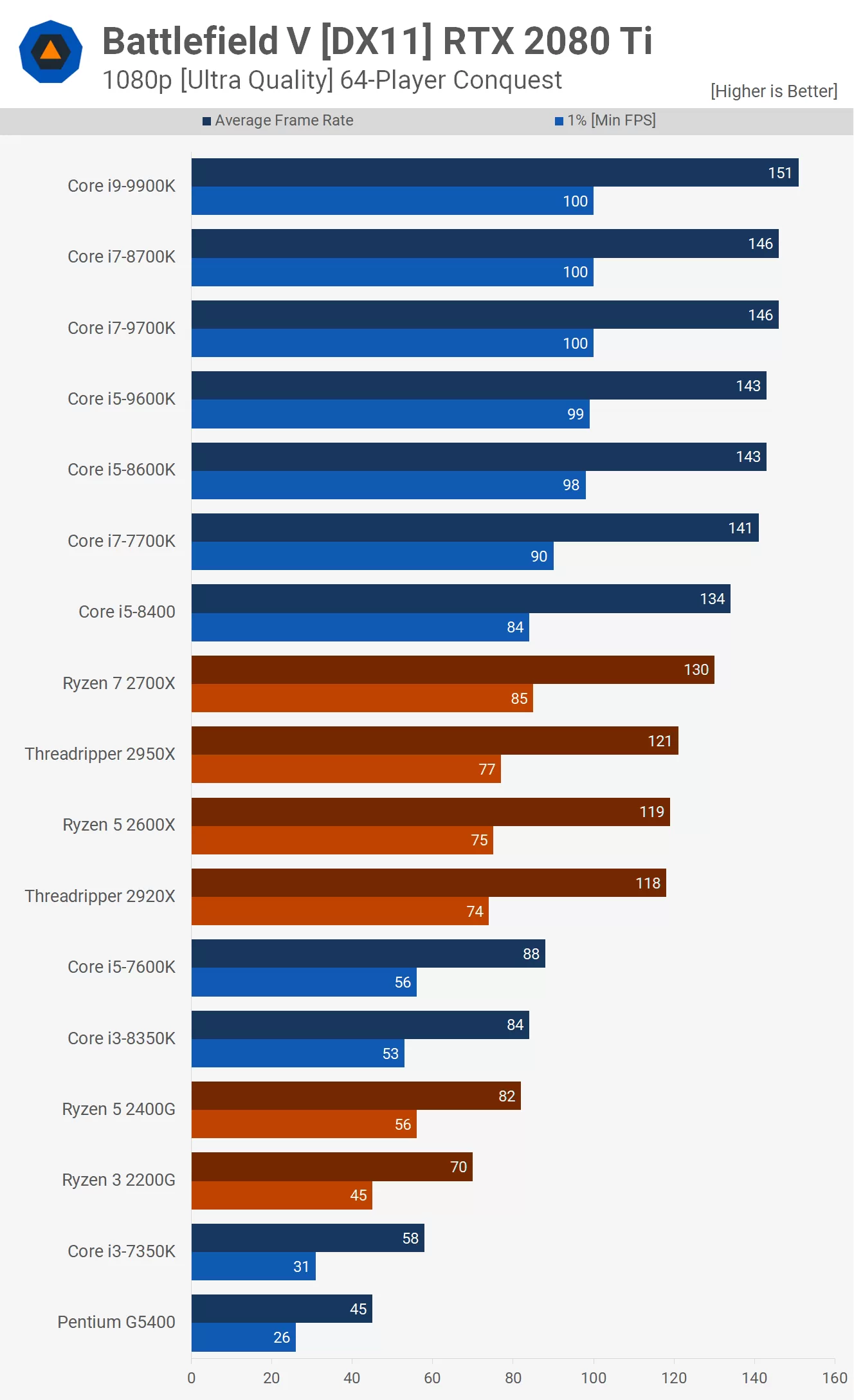
Information technology'south interesting to run into the one time mighty Cadre i5-7600K struggling here. The Ryzen 5 2400G was comparable to the 7600K and that's not something we often encounter, if e'er. And so we see the Ryzen 3 2200G comfortably beating the Core i3-7350K and Pentium G5400. Basically anything dual-core is going to get destroyed by the 2200G quad-core, fifty-fifty if they have Hyper-Threading.
And so a decent showing from AMD at the low-end, merely not bang-up at the high-stop. That said, if you're not using an RTX 2080 Ti at 1080p, with ray tracing disabled, what does Ryzen take to offer?

Here is a comparing between the Ryzen 7 2700X and Core i9-9900K. At the top of the graph we run into the previous RTX 2080 Ti result at 1080p and hither the Intel CPU offered a 16% functioning boost for the average frame rate and xviii% for the 1% low, so a decent performance advantage offered past Intel.
Switching to the RTX 2080 didn't alter much and we are even so mostly CPU jump at 1080p. Here the 9900K was 11% faster for the boilerplate frame rate and 15% faster for the frame fourth dimension result. So for those seeking maximum performance at 1080p the 9900K seems like the way to become.
All the same if y'all're using a more than mid-range GPU like the RTX 2070 and then it appears you lot'll receive a similar level of performance with either the 2700X or 9900K. Here the Intel CPU was two% faster for the average frame rate and 5% faster for the i% low which is a negligible difference.
Using any GPU that'south slower than the RTX 2070 will see no deviation between these two CPUs at 1080p using the ultra quality settings and we come across that to be the case with the GTX 1070. Simply what if you want to game at 1440p and that resolution certainly seems more than fitting for all four GPUs tested here.

As we go GPU limited, at 1440p we see very little difference between the 2700X and 9900K using the GTX 1070, RTX 2070 and even the RTX 2080. The 9900K nonetheless offered a superior gaming feel at 1440p when using the RTX 2080 Ti, hither it was 13% faster on average with a 21% greater frame fourth dimension upshot.

Now assuming you purchased the 2080 Ti for shine 4K gaming, it appears the pick of CPU doesn't matter all that much when comparison high-terminate AMD and Intel chips on this game. Even with the RTX 2080 Ti both CPUs enabled the aforementioned level of performance, hitting around fourscore fps on average with a 1% depression of 65 fps.
Closing Remarks
Battlefield Five is playable on quad-cores only you can expect frequent frame dips, resulting in less consistent frame rates. For the nearly part, we've found that the older Core i5-7600K has been hanging in there pretty well with AAA titles released in 2022, simply for the multiplayer portion of Battlefield V you lot will desire to avoid the large 64-histrion battles.
This also means for smooth consistent gameplay the Core i3 range along with the quad-core Ryzen CPUs are a write off. Of course, if you're willing to accept regular stuttering and dips below 60fps then you can still make do with these processors.

If we were edifice a PC exclusively to play Battlefield V at the highest possible frame rates with cypher else in mind, we'd probably become the Core i5-8600K. Nevertheless for just $10 more, the Ryzen 7 2700 gives you lot a better upgrade path down the line, comes with a cooler and information technology is a meliorate value for overall computing. Using an RTX 2070 or slower using the ultra quality settings, you volition be GPU jump and information technology won't really matter which processor you use. Alternatively, if you're running on high or even medium settings for maximum frame rates, then you will start to encounter a larger benefit of going with the higher clocked, lower latency Intel CPU.
Overall, we call up Ryzen looks a bit disappointing at 1080p where the game is not GPU limited, though given the clock speed deficit, it's impressive the 2700X is just 15% slower than the 9900K. Go along in mind that both AMD and Intel CPUs can be overclocked for greater performance and retentiveness timings can be manually tuned, which is beneficial on both platforms. Mostly speaking, AMD does better with memory tuning, while Intel gains more from core overclocking.
Shopping Shortcuts
- Intel Core i9-9900K on Amazon, Newegg
- Intel Core i5-8600K on Amazon, Newegg
- Intel Z390 motherboards on Amazon, Newegg
- AMD Ryzen 7 2700X on Amazon, Newegg
- AMD Ryzen 5 2600 on Amazon, Newegg
- AMD X470 motherboards on Amazon
GPU Selection
- Radeon RX 570 on Amazon
- Radeon RX 580 on Amazon
- GeForce GTX 1060 6GB on Amazon
- GeForce GTX 1070 Ti on Amazon
- GeForce GTX 1080 on Amazon, Newegg
- GeForce RTX 2080 on Amazon, Newegg
- GeForce RTX 2080 Ti on Amazon, Newegg

Source: https://www.techspot.com/review/1754-battlefield-5-cpu-multiplayer-bench/
Posted by: garciasounedithe.blogspot.com
0 Response to "Battlefield V Multiplayer CPU Benchmark: Ryzen 7 2700X vs. Core i9-9900K"
Post a Comment